Categories
The Original Oakley Fiefdoms

Dr. Varnum’s Oakley Investment (1877-1881)

On February 9, 1877, Dr. George Washington Varnum of Montgomery City, Missouri purchased thirteen acres of Oakley Farm that bordered the western City Limits of Cambridge.  He paid Oakley Farm’s owner, Samuel L Byrn, $1749.  Varnum, who did not have any obvious connection to Cambridge or the Eastern Shore, was the first Oakley Farm speculator to subdivide his land into home building lots.  He built Varnum’s Alley, now renamed Choptank Avenue, along the eastern edge of his property.  He also extended Locust Street along the southern edge of his property (naming it Locust Street Extended). 

His first sale on 3/1/1878 was a large lot (125 ft x 250 ft) to John Davis who was a ship’s carpenter by trade. Davis paid $500 for the lot. Within a month Davis employed a contractor to begin building the house that today still stands at 801 Locust Street. Unfortunately, within 6 months Davis was forced to sell this and other property to pay off his debts. Within the following 2 years Varnum sold 2 more adjacent properties at $250 apiece.  Homes were quickly built on each of these properties.  All 3 homes (Davis (801), Henry Meekins (805), and James Ennis (807)) are still standing today. By 1886 James A Ennis, who was a carpenter and contractor, enlarged 807. And by 1911 it was enlarged into a 2-family dwelling.

After 4 years, Varnum had only managed to sell 13% of his Oakley property.  So, it is not surprising that in 1881 he sold all of his remaining land to a new investors group, the Building and Loan Association of Cambridge, for $2000. This investors’ group was headed by local attorney Henry Lloyd (soon to be Maryland Governor) and Cambridge architect and building contractor J. Benjamin Brown (soon to be first Mayor of Cambridge).  The Building and Loan Association of Cambridge were very successful selling a large number of building lots, but that is a story for another day.

The Varnums

In 1775 the fifth generation of American Varnums were still living on their original farm along the Merrimack River in Dracut, MA.  However, on April 19, 1775 Joseph Bradley Varnum, Dr. George Varnum’s grandfather, left his farm to lead a militia unit that fought at Lexington and Concord.  The American Revolution had begun and Joseph began a lifetime of service to his country.  Joseph eventually became Brigadier General Varnum, but more importantly by 1795 he was elected to the Fourth Session of the US House of Representatives.  This was 5 years before the Federal government moved from Philadelphia to Washington.  He served in the Congress for 22 years, first as a US Congressman and then as a US Senator.  It is noteworthy that he served as Speaker of the House and later as President Pro Tempore of the Senate during his Congressional career.

Doctor Varnum’s father, Jacob, made his way to Washington, DC as a merchant, not a politician.  However, in 1828 the family moved to Petersburg, VA where Jacob  became a very successful merchant.

Dr. George Varnum grew up in Petersburg before attending the University of Pennsylvania Medical School.  He graduated with a medical degree in 1845.  After 5 years as a resident physician he returned to Petersburg and opened a medical practice.  However, after the Civil War began, George left Petersburg to help the Union war effort.  He received a commission as “surgeon, US Volunteers”.  In 1863 George was assigned to the Ninth Division, Thirteenth Army Corps who were involved in laying siege to Vicksburg.  However, within 6 months he caught malaria and had to resign his commission.  He could not return home to the Confederate controlled Petersburg, so instead he established his medical practice in Montgomery City, Missouri.

After the War, George’s father moved to the District of Columbia.  In 1868 Dr. Varnum, who was a widower, married again and continued to live in Missouri.  When Jacob Varnum died in DC in 1874, Dr. George Varnum, his only heir, became executor of his estate.  Jacob’s will made it clear that George should invest a portion of his inheritance from Jacob in real estate in order to provide tuition for his children’s college education.  Jacob’s will further suggested that his son invest in new home mortgages.  This seems to explain why in 1877 Dr. Varnum purchased farmland with the intent of subdividing it into building lots that he could sell.

What’s the Cambridge Connection?

Why did Varnum chose Cambridge for his investments?  In fact, even though Dr. Varnum continued to maintain his residence in Missouri after purchasing the Cambridge property, both a daughter and son were born in Cambridge.  The clue as to why he made an investment in Cambridge is revealed by his daughter’s birthname, Lottie Goldsborough Varnum.  It suggests that he had met and become acquainted with at least one member of the Cambridge Goldsborough family.  Was it during his time in Pennsylvania?  Or maybe during the Civil War in Washington or Vicksburg?  Or was it through Varnum’s grandfather who served in the US Senate with Robert Henry Goldsborough from Talbot County?

Doctor Varnum’s Epilogue 

After selling his Cambridge investments, Dr. Varnum only stayed in Montgomery, MO for 3 more years.  In 1884 he picked up his family of 6 and headed West.  Many years later his son James Edgar would write an eyewitness account of his family’s 1884 move from Missouri.  He wrote that his father fell prey to “hypnotic real estate literature” from California.  In the 1880’s Southern California real estate developers were sending out marketing materials across the country as they tried to sell building lots. It was a developer in Lake Elsinore, California who was able to hook Dr, Varnum.  In September of 1884, the Varnum family climbed aboard a train for a 10-day trip to their new home.  They also brought with them 2 carpenters, a seamstress, a horse, and nine head of prize-winning Jersey cattle.  And they also brought all the material required to erect a new house.  The Varnums stayed in Lake Elsinore less than 10 years before moving first to San Diego and then to Los Angeles where he died in 1910.

Varnum’s Incredible Signature (Autograph) Collection

In 1906 a story appeared in the LA Evening Express newspaper.  It was titled “Dr Varnum’s Interesting Collection of Autographs”.  It was revealed that “One of the most valuable private collections of autographs in the US” belonged to Dr. George Varnum.  The article goes on to list dozens of original autographs in the collection.  For example, he had original signatures of 13 of the first 16 presidents including Washington, Jefferson, and Lincoln.  He had almost half the signers of the Declaration of Independence and many other autographs of famous 19th Century people .    When his collection was sold in 1928 at a New York City auction, it brought in over $18,000.  Today his William Henry Harrison autograph alone would fetch more than $100,000.
Categories
The Byrns The Original Oakley Fiefdoms

Rich Henry Hubbard of James (1803-1883)

Rich Henry Hubbard of James was one of the seven investors in Samuel L. Byrn’s Oakley Farm.  In 1875 he loaned Byrn $3300.  The loan was secured with a mortgage against Byrn’s Oakley acreage (78 acres at that time). Then, as Byrn continued to sell off his acreage to other investors, he paid Hubbard a portion of the selling prices to get clear title for each sale.  Upon Byrn’s death in 1878, Hubbard, as the Oakley mortgage holder, auctioned off what was then a 53-acre farm.  We begin the 2024 Oakley Farm posts with what we know about Mr. Hubbard’s life.

In 1803 Henry Hubbard was the first child born to farmer James Henry Hubbard and his wife Amelia Marshall Hubbard.  They lived in the Neck District of Dorchester County in a neighborhood called James.  James was centered at the intersection of Hudson, Hills Point, and Cassons Neck roads.  We have no current population total for James, but a 1940’s Cambridge map estimated it as about 300 people.

As a young man Henry started working on a bay vessel as a cook.  Eventually he purchased a bay vessel of his own.  We therefor assume that he was a waterman in his early years.

When he was 30 years old, Henry married Ann Applegarth.  They lived on one acre on the east edge of Brooks Creek.  Two years later he purchased the 75-acre Dail’s Addition farm.  Census records from 1840 through the end of his life indicate that Henry continued to live on a farm in the James area and described himself as a farmer. He also acquired many more acres of land in the period leading up to the Civil War.  By the eve of the Civil War, he reported on the 1860 census that his property was worth $5000, and that he had a personal estate worth $10,000.  So, by 1860 at the age of 57 Henry Hubbard was a moderately successful farmer and waterman.

What a difference a decade makes!  Henry Hubbard’s fortunes changed during the 1860’s, specifically during the Civil War.  He was hired by the Federal government to transport supplies to Union troops engaged in a standoff with Confederate troops along the Rappahannock River in Virginia.  Two facts stand out from this period of Henry’s life.  First, he was involved in a risky business.  In fact, per the Baltimore Sun, his boat came under fire and was once hit and nearly sunk.  Secondly, the risk was high, but the rewards were higher.  His transportation of supplies for the Union Army was so lucrative, he became a very wealthy man.

After 1870 we find Henry referred to as “Rich Henry Hubbard of James”.  People in Dorchester County added the nickname of “Rich Henry”, but it appears that Henry added “of James” to his title.  He is referred to as Henry Hubbard of James in all of his deeds and mortgage documents at the Dorchester County Court House after 1870.  In addition to his mortgage on Oakley Farm he became one of the major providers of mortgages in Dorchester County between 1870 and his death in 1885.

As previously mentioned Hubbard lived in James his entire life. In 1815 the Spedden family donated land to build the Spedden M. E. Church at the center of James. This was the church that the Hubbards attended. So, it should not be surprising that when the church members decided to build a new church building on the same site in 1874, Henry Hubbard stepped up and made a big donation to the building fund. However, Henry “requested” that the church name be changed to the Hubbard’s Chapel M. E. Church. The church name was changed per Hubbard’s request. At a later date the church name was changed again. Today the Spedden United Methodist Church can still be found in the center of James.

On October 14, 1885, the Baltimore Sun reported that at the age of 82, “Rich” Henry Hubbard had died at his home on Ross Neck in Dorchester County. The newspapers estimated that he had accumulated property worth over $60,000.  That would be equivalent to approximately $2,000,000 today!

Categories
The Byrns The Original Oakley Fiefdoms

Byrn sells Oakley to 7 Investors (1874 to 1878)

For its first 150 years 100-acre Oakley Farm was owned by a succession of owners – including Foulkes, Watson, a few Lockermans, Haskins, Scott, 2 Ecclestons, Pattison, and a Jackson.  However, in 1853 Samuel L. Byrn became the final Oakley Farm owner.  Byrn purchased Oakley Farm in 1853 from a trustee in a court case involving Oakley owner Benjamin D. Jackson.  He maintained the farm, but also during the 1850’s Byrn was a partner in the Byrn & Rea dry goods store on Poplar Street.  In 1866 he considered selling some Oakley land to the Dorchester and Delaware RR, but the railroad instead opted for a site on Cambridge Creek for their new terminal.

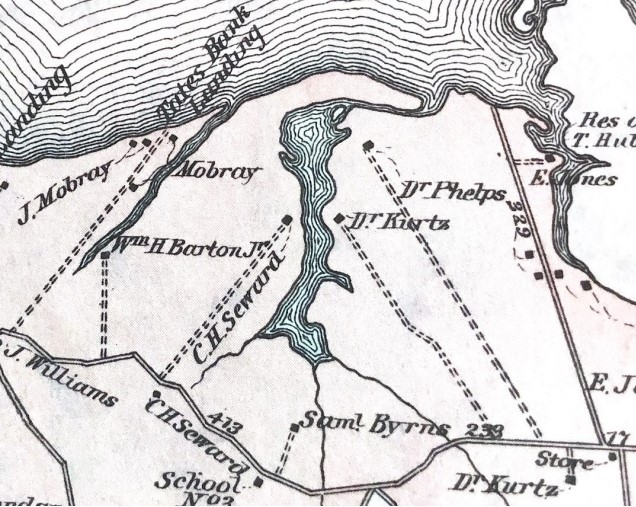
Next in 1870 after he paid off his Oakley mortgage, he bought Wilton farm located on Hurst Creek.  The location of Wilton’s main house is labeled with “Saml Byrns” on the 1877 Dorchester County map to the left. We are not sure if it was his intention at the time to move to Wilton or if it was just an investment.

For whatever reason, Byrn’s Oakley land sales began in 1874.  Why did he begin to sell then?  It is not clear why, but here are a few obvious possibilities.  He paid $6000 for Wilton in 1870.  That may have caused some cash flow problems.  Or he may have been facing financial problems related to the Great Depression spawned by The Panic of 1873.  Of course, there is also the possibility that he simply saw the potential for a western suburb for Cambridge and created a plan to subdivide and sell off Oakley and move to Wilton. 

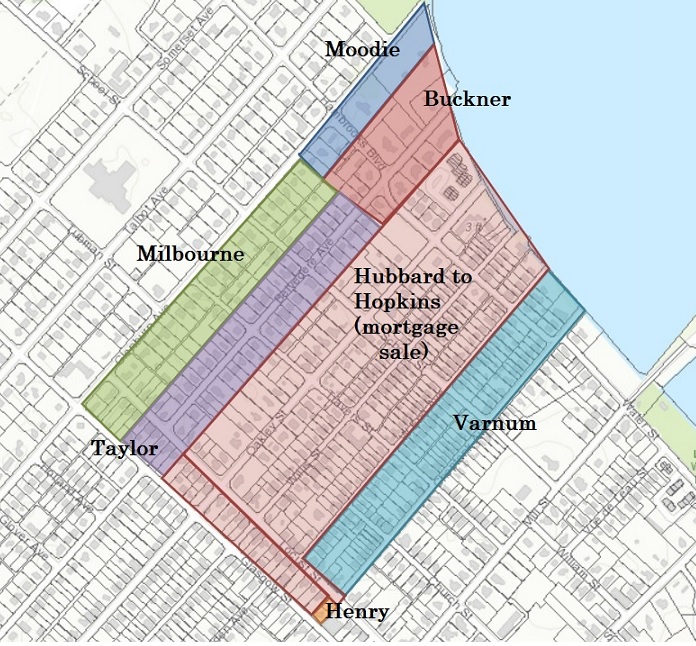
The first purchasers acquired their Oakley Property on 7/30/1874.  On that date Byrn sold 2 adjacent lots of land on the Choptank River at the northern tip of Oakley.  One 4-acre lot was sold to James and Sophia A. Moodie, newcomers to Cambridge.  This lot was at the very corner of Oakley and up against E. N. Clark’s Glenburn Farm.  They paid $370 and after adding a dwelling they sold it 2 years later for $700.  Moodie’s 4-acre lot, like the other 5 blocks of land discussed below, would eventually be resold and subdivided multiple times before achieving their current shapes.

On the same day in 1874 Byrn sold an adjacent 6-acre lot east of Moodie’s lot to Alfred & Emily Buckner.  Alfred Buckner was a waterman.  He built a simple house about 40 feet from the shore.  The Buckners sold their house and property after only a year.  They paid $462 and sold it 1 year later for $700.  According to the deeds Byrn also conveyed a 16-foot wide right of way to both properties along the property line with Glenburn Farm all the way from “the road to Sandy Hill”. 

Next, we find a mortgage in September of 1875 for Oakley.  We learn two important things from the mortgage.  First, Byrn owed Henry Hubbard of James $3300 and secured that debt with a mortgage against all his remaining Oakley acreage.  Secondly, we learn that Byrn had previously sold a 12-acre lot along the northwest edge of Oakley to prominent Dorchester attorney Sewell T. Milbourne.  However, he had failed to file the deed.  Milbourne’s lot abutted E. N. Clark’s Glenburn Farm and extended from the road to Sandy Hill to the Moodie property.  It did not appear to include the 16 foot right of way Byrn granted to Moodie and Buckner.  So, Milbourne became the third investor.  Hubbard’s mortgage on Oakley in 1875 actually covered 78 acres and excluded the 22 acres of Oakley land already sold by Byrn.

The fourth Oakley investor, Ann and J. C. Henry, bought a quarter-acre lot in February of 1876 at the southernmost tip of Oakley Farm on what is now Glasgow Street.  They then built a new house.  We can see the outline of the house on the 1877 map of Cambridge. The house is now numbered 701 Glasgow Street.  It is noteworthy because it is the oldest house still standing on Byrn’s Oakley Farm property.  The lot it sits on is now only half as big because in 1892 the north half of the lot was sold and a new house facing Locust Street was built (now 800 Locust Street).  I believe J. C. Henry was a druggist in Easton and the descendant of the Henrys who were longtime owners of Hambrooks Manor. 

In February of 1877 Dr. George Washington Varnum from Missouri became Oakley’s fifth investor when he purchased a 13-acre parcel from Byrn.  Actually Dr. Varnum, as executor, made the purchase on behalf of his late father’s estate.  His parcel is bordered today by the northern curb of Locust Street, the east curb of Choptank Avenue, the east curb of West End Avenue, and the Choptank River.  Varnum immediately began marketing and selling Oakley building lots. His instructions as executor per his father’s will was to make investments that would continue to increase the estate’s value until the grandchildren mentioned in the will reached 21 years old.  While it is not clear how much time Varnum spent in Cambridge, a daughter was born in Cambridge in 1877 (with the middle name of Goldsborough) and a son was born in Cambridge 3 years later.  Varnum sold some building lots before selling his remaining Oakley property to Cambridge Building and Loan in 1881.  Varnum family background and the story of his Choptank Avenue tract will require additional posts.  Note that the first name for Choptank Avenue was Varnum’s Alley.

Byrn’s final sale occurred on 11/20/1877.  On that date he sold a 12 acre farm to investor number six, Andrew G. Taylor of Wilmington, DE.  His tract included most of what is now Belvedere Avenue plus the property between Locust and Glasgow Streets that lined up with the width of the Belvedere block.  At its northeast terminus it abutted the property purchased by Buckner referenced above. Taylor’s purchase was unique because he apparently farmed the land and did not intend to subdivide it.  We do not know how much time he spent at his farm because he lived in Wilmington, DE and was a painter working for the Philadelphia, Wilmington & Baltimore Railroad.  What we do know is that a year later in 1878 he purchased 6 additional acres adjacent to his farm which gave him an 18-acre farm stretching to the Choptank River.  This additional 6 acres was the lot that had been previously sold by Byrn to Alfred Buckner in 1874.  As previously noted, Buckner had built a house on his property, so Taylor’s farm now also had a house.

The final chapter to this part of the Oakley story began when Samuel Byrn died the following year in 1878. At that time, he owned less than 53 acres and all of that was mortgaged to Oakley’s seventh investor, Henry Hubbard.  You may also be wondering how Byrn was able to sell the last 3 properties while Hubbard held a mortgage on them.  In each case there is evidence that Byrn paid an agreed upon amount to Hubbard from each sale in order to clear the titles.  So, when Byrn died Rich Henry Hubbard, as he was known, had a mortgage on a 53-acre Oakley Farm.  Hubbard was referred to as Rich Henry Hubbard because he was a shrewd investor who owned close to $2,000,000 in property in today’s dollars.  In September of 1878 Byrn’s Oakley property was sold by mortgagee Hubbard to farmer, real estate investor, and former boat yard owner William Hopkins for $3000.  In the meantime, Mrs. Margaret Byrn and 4 of her children moved to Wilton Farm.  The children were all adults except 15-year-old Samuel.  However, Samuel would, in fact, return to Oakley (Street) to live almost 50 years later! 

With one exception the map below shows the name of the property owner who purchased the tract of land from Samuel Byrn. However, the area labelled “Hubbard” was Byrn’s land that had been mortgaged to Hubbard. Upon Byrn’s death on 5/29/1878 a mortgage sale was triggered that resulted in Byrn’s 53 acres being conveyed to William Hopkins. One other clarification is that the Moodie and Buckner lots total 10 acres according to their original deeds (4 for Moodie & 6 for Buckner). The map rendering below is a bit skewed for these lots because the actual 1874 shoreline and marsh land are not taken into account. In a future post about the development of these 2 parcels an interesting 1916 court case will provide a more accurate depiction of these lots.